Which PS2 BIOS to Use? The Only Guide You Need (2026)
You downloaded the emulator PCSX2. You picked your favorite PS2 game. You press play. Nothing. A black screen is staring back at you, or even worse, an error message you have never even seen before. Sound familiar?
This is one of the most annoying situations a person could face when getting into PS2 emulation. Most tutorials online simply gloss over the details or offer the generic “just use v2.00” answer without explaining why. This leaves the person guessing, downloading again, and still getting crashes.
This guide will help you avoid all of that. You will learn exactly which PS2 BIOS to use based on the games you have in your collection, the system you are using, the region you live in, and the emulator you chose. BIOS to use based on your game library, your system, your region, and your emulator.
What Is PS2 BIOS and Why Does It Matter?
The PS2 BIOS (Basic Input/Output System) is a program that comes from a real PlayStation 2 console. It serves as a foundation for your emulator to work. Without it, your PCSX2 emulator won’t even start a game.
Here’s a nice analogy to get it into perspective: The BIOS of a PlayStation 2 system can be likened to a “soul” that guides your emulator on what to do with the memory, discs, hardware, etc., to start a game. Use the wrong one, and your emulator either fails silently or throws region errors.
You can read more about what it does technically on our PS2 BIOS download page.
Understanding the PS2 BIOS Versions List
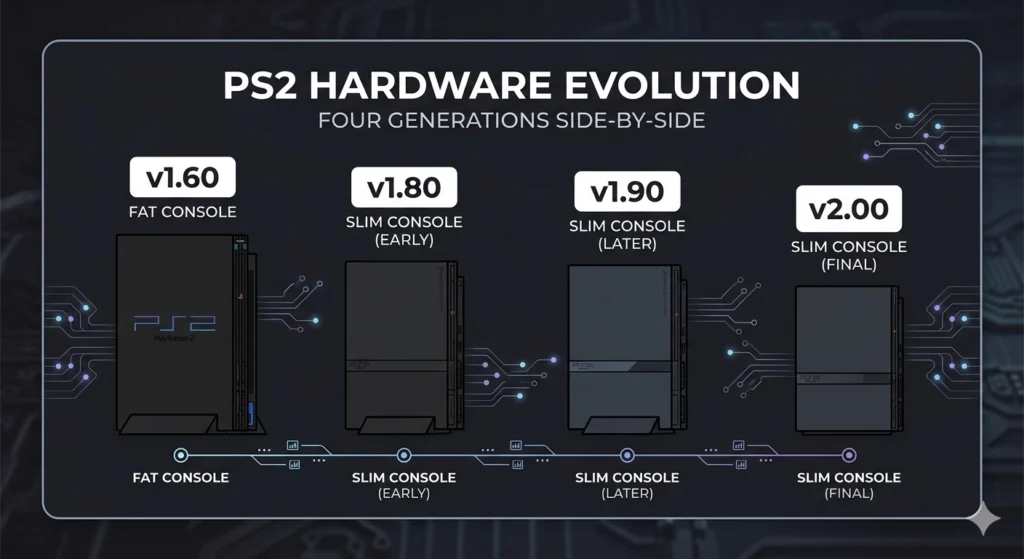
Sony released the PS2 across multiple years and regions. Each hardware revision came with its own BIOS. These are not just numbered differently for marketing. They carry genuine differences in stability, regional support, and hardware behavior.
Here is the complete PS2 BIOS versions list with what each one actually means:
BIOS Version | Era | Best For | Notes |
v1.60 | 2000 to 2001 | Early Japanese titles | First generation, limited optimization |
v1.70 | 2001 to 2002 | Early NTSC-U and NTSC-J games | Improved over v1.60, still not ideal for newer titles |
v1.90 | 2002 to 2004 | Most mid-era PS2 games | Strong balance of compatibility and stability |
v2.00 | 2004 onward | Late-era and modern emulation | Best overall stability, higher CPU demand |
These are the core PS2 BIOS versions that matter for emulation. Anything below v1.60 is too outdated to be practically useful on modern emulators.
Regional BIOS Breakdown: Match Your Game, Not Just Your Preference
This is the part that confuses people the most. The reason for this is that the PS2 is region locked at a hardware level. Each region has its own BIOS, which is tweaked for the region’s video standards and language system.
The following are the four major regional types:
USA BIOS (NTSC-U)
Console models: SCPH-39001, SCPH-70012 This is probably the most compatible version for English language games. It is a 60Hz version, which is compatible with most NTSC video standards. It is used for the majority of the PS2 games. If you’re only going to use a single version, then this is probably your best bet.
Japan BIOS (NTSC-J)
Console models: SCPH-10000, SCPH-18000 The NTSC-J version is a must-have for playing Japanese-only releases. There are some old Japanese-only releases for the PS2 that have region checks. These cause instability if you try to run these games on the USA version. It is recommended that you have this version, even if you don’t have many Japanese releases.
Europe and Australia BIOS (PAL)
These console models are SCPH-50003 and SCPH-75004. The 50Hz frequency, which is the standard for this BIOS, was used in broadcasting in Europe and Australia. Playing PAL games with an NTSC BIOS can cause problems with timing, music speed, and visual effects. If your game library is in PAL format, this BIOS is not optional.
China and Other Territories (NTSC-C / PAL)
This is the least documented BIOS variant. Its region includes China and surrounding territories, using either the NTSC-C or a PAL derivative frequency, depending on the region. There is little need for this BIOS unless you have specific Chinese-region PlayStation 2 releases.
The PS2 BIOS version differences Explained Clearly
This is where most guides fail you. They’ll list all these versions, but they’ll never inform you of what changes between them.
v1.60 vs. v1.70: Some of the hardware problems that were present on the first Japanese console releases were fixed with the jump from v1.60 to v1.70. If you are playing games from Japan that are part of the SCPH-10000 or SCPH-30000 series, then v1.60 is real. If you need something else, v1.70 is the best choice.
Version 1.90 finally made some real improvements to memory management over version 1.70. If your games stutter or have sound problems on v1.70, they should work perfectly on v1.90. Just so you know, v1.90 uses a little more resources than v1.70.
v1.90 vs. v2.00: Most people won’t notice the differences between the PS2 BIOS versions for these two. Version 2.00 has improved boot times and made improvements for discs from the late era. For general-purpose emulation, v1.90 and v2.00 are almost the samel. For high-end systems, v2.00 has a slight edge.
Which PS2 BIOS to Use for PCSX2?
This is the most searched question, and the answer depends on two things: your game library and your hardware.
For general use on PCSX2 (Windows, macOS, Linux): Use the USA BIOS from the SCPH-70012 model running v1.90 or v2.00. This combination covers the widest range of games and performs reliably across modern hardware.
For Japanese game collections: Switch to NTSC-J v1.60 or v1.70. Some early Japanese titles contain boot routines that behave differently under a non-Japanese BIOS.
For European game libraries: The PAL BIOS from SCPH-90004 running v2.00 is the correct choice. PAL games rely on 50Hz timing, and using an NTSC BIOS will produce noticeable speed and sync issues.
For low-end machines: PCSX2 on older hardware benefits from lighter BIOS versions. Try v1.70 or v1.90 before defaulting to v2.00. The difference in CPU load is small but real.
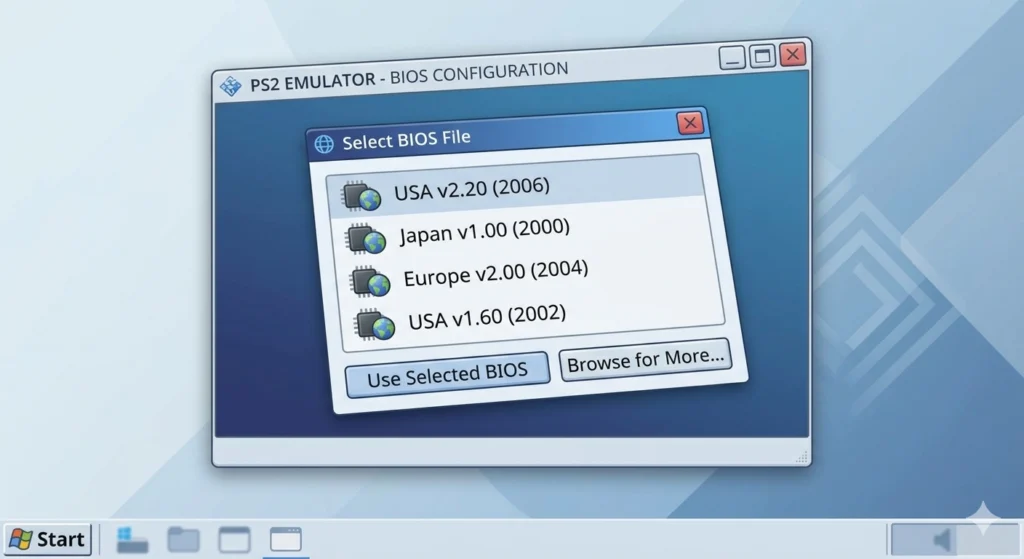
The PS2 BIOS select version setting in PCSX2 is found under Config, then BIOS. You can store multiple BIOS files in the same folder and switch between them without reinstalling anything.
For a full walkthrough on setting this up, visit our How to Install PS2 BIOS page.
Which PS2 BIOS to Use for AetherSX2 (Android)?
AetherSX2 is the go-to PS2 emulator on Android. Its BIOS behavior differs slightly from PCSX2 because mobile hardware handles processing differently.
Recommended for AetherSX2: USA BIOS (SCPH-70012), version v1.90 or v2.00.
The reasoning is practical. AetherSX2 is optimized primarily around the NTSC-U standard. The USA BIOS produces fewer compatibility errors on Android, loads faster, and requires less troubleshooting for most game libraries.
If you have Japanese titles in your collection and they fail to load cleanly, add the NTSC-J BIOS alongside the USA BIOS. AetherSX2 lets you store and switch between multiple BIOS files, so there is no reason to limit yourself to one.
For a step-by-step process, visit our Guide to Update Your PS2 BIOS page, where we walk through the complete setup.
PS2 BIOS select version: How to Use Multiple BIOS Files
A common misunderstanding is that you can only have one BIOS installed. That is not true. Both PCSX2 and AetherSX2 allow you to place multiple BIOS files in the designated BIOS folder and switch between them from the emulator settings.
This is useful when:
- A specific game boots incorrectly under your default BIOS
- You switch between Japanese and English game libraries regularly
- You want to test whether a BIOS version is causing a compatibility issue
The PS2 BIOS select version feature in PCSX2 is accessible from the main Config menu. In AetherSX2, you access it through Settings, then BIOS. No reinstallation is needed when switching.
Common BIOS Errors and What They Mean
No BIOS file found
The emulator cannot locate a BIOS file in the designated folder. Check your BIOS folder path in the emulator settings.
BIOS version not supported
You may be using an incompatible or corrupted BIOS file. Re-extract from your console or try a different version.
Region mismatch
Your BIOS region does not match the game region. Switch to the matching regional BIOS from the ps2 bios select version menu.
Black screen after BIOS loads
This is often a game compatibility issue rather than a BIOS issue. Try switching between v1.90 and v2.00, as this resolves the issue in many cases.
Best PS2 BIOS Version: Our Recommendation
After testing compatibility across hundreds of titles, here is the clearest recommendation we can give:
The best PS2 BIOS version for most players is v1.90 or v2.00 from the SCPH-70012 (USA) series.
It covers the broadest library, runs cleanly on both high-end and mid-range hardware, and requires the least amount of troubleshooting. If you play a mix of American, European, and Japanese games, store all three regional BIOS files and switch as needed.
For early PS2 titles from 2000 to 2002, consider testing v1.60 if you hit issues with v2.00. Some launch-era games contain boot logic that the newer BIOS handles slightly differently.
How to Install PS2 BIOS on EmuDeck (Windows)
EmuDeck is also available for Windows. The folder structure mirrors the Steam Deck version but uses Windows-style paths. Here is how to install PS2 BIOS on Emudeck for Windows users:
Step 1: Install EmuDeck for Windows
Download EmuDeck from emudeck.com and run the installer. Follow the setup prompts and choose your storage location (main drive or external drive).
Step 2: Find the BIOS folder
EmuDeck creates its folder structure at the path you selected during setup. The BIOS folder will be at: [Your chosen drive]\Emulation\bios\
Step 3: Place your extracted BIOS file
Drop your extracted .bin file directly into the bios folder. Follow the same critical rule as the Steam Deck version: no subfolders. Files go in the root of bios, nothing else.
Step 4: Confirm detection in PCSX2
Open PCSX2 through EmuDeck or directly. Go to Settings > BIOS. Your file should appear automatically. If it does not, click Browse, navigate to the *Emulation\bios* folder, and select it manually.
Which Games Work Best on Each BIOS Version
Game Type | Recommended BIOS Version | Region |
Early launch titles (2000 to 2002) | v1.60 or v1.70 | Match to game region |
Mid-era RPGs and action games | v1.90 | NTSC-U or NTSC-J |
Late-era titles (2005 onward) | v2.00 | NTSC-U or PAL |
Japanese exclusives | v1.60 to v1.90 | NTSC-J |
PAL exclusives | v1.90 or v2.00 | PAL |
For a list of top-performing PS2 games on PCSX2, visit our Best PS2 Games page.
Quick Reference: PS2 which BIOS to use
Use this as your fast-reference guide before any setup:
- Playing NTSC-U games on PCSX2 or AetherSX2: Use USA BIOS v1.90 or v2.00 (SCPH-70012)
- Playing Japanese games: Use NTSC-J BIOS v1.60 to v1.90 (SCPH-10000 or SCPH-30000)
- Playing PAL games: Use European BIOS v1.90 or v2.00 (SCPH-90004)
- Low-end hardware: Start with v1.70 or v1.90 to reduce CPU load
- Maximum compatibility across all games: Store all three regional BIOS files and switch as needed
Final Word
Choosing the right BIOS is not complicated once you understand what each version and region actually does. The ps2 bios version differences between v1.90 and v2.00 are small for most players, but the difference between using the right regional BIOS and the wrong one can mean the difference between a game that runs perfectly and one that crashes on startup.
Match your region. Store multiple BIOS files. Start with v1.90 or v2.00. Test when something does not work. That is the entire strategy, and it works.
If you need help with the download or the installation process, our dedicated pages walk you through every step. Check out our PS2 BIOS download page to get started.